China’s laser manufacturing sector continues to influence global production in 2026. Its suppliers serve metalworking, signage, electronics, automotive, and fabrication businesses. This guide examines ten leading Chinese manufacturers shaping that market.
The evaluation considers cutting accuracy, laser source quality, machine stability, software usability, and after-sales support. Factory experience also matters. A reliable Laser Machine should deliver consistent edges, repeatable positioning, and manageable maintenance costs. Buyers need more than attractive specifications. They need clear warranties, responsive engineers, documented testing, and practical installation support.
Details matter. Evidence matters.
The selected companies are assessed through public technical information, manufacturing capabilities, customer feedback, export experience, and industry reputation. Attention is given to fiber laser cutters, laser engravers, laser welders, and integrated production systems. Real workshop conditions can reveal weaknesses that brochures hide, including vibration, dust control, cooling performance, and operator training.
This is not an absolute ranking. Different manufacturers suit different materials, budgets, production volumes, and service expectations. A small signage workshop may value compact design and simple software. A large factory may prioritize automation, uptime, and standardized parts. Some suppliers communicate technical details well, while others leave important questions unanswered. That gap deserves scrutiny.
The 2026 market also brings uncertainty. Component availability, regional service networks, and changing import requirements can affect ownership costs. Readers should verify certifications, machine configurations, delivery terms, and local support before purchasing. The companies discussed here represent strong candidates, but independent testing remains valuable. A careful decision begins with evidence, not marketing language.
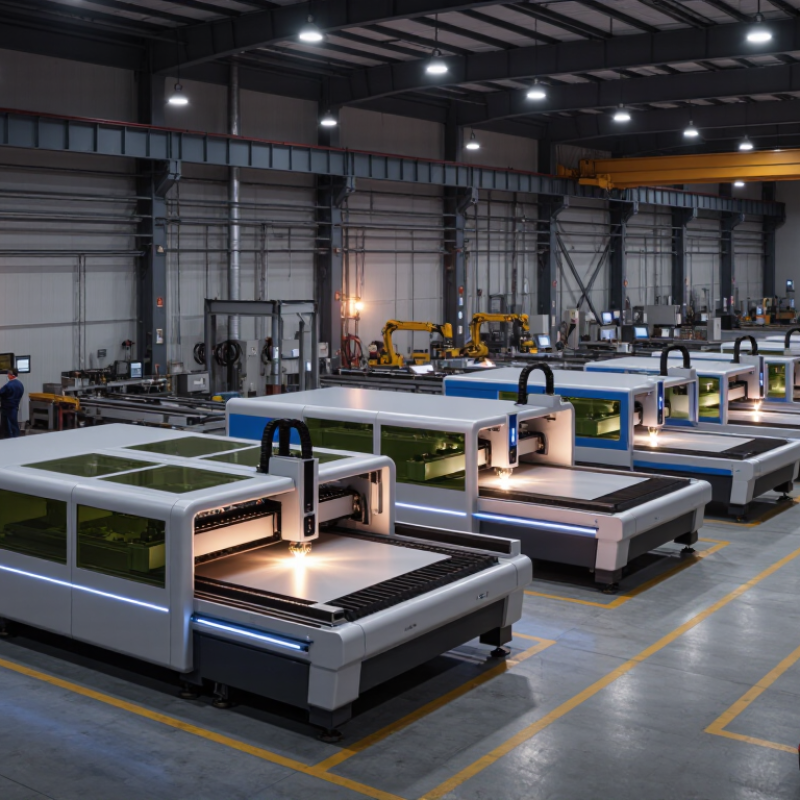
How China’s Top 10 Laser Machine Makers Are Ranked in 2026
The 2026 ranking evaluates ten Chinese laser machine manufacturers through measurable operating evidence, not advertising claims. Market scale matters. Fortune Business Insights projects the global laser cutting machine market to grow strongly through 2032, while Grand View Research reports continuing demand for automated industrial laser systems. These forecasts support the sector’s momentum, but they do not prove machine quality.
Our assessment gives 30% weight to cutting accuracy and repeatability, measured through stainless steel, carbon steel, and aluminum trials. Production uptime receives 25%. Export experience, safety certification, spare-parts availability, and service response share the remaining score. A practical test includes a 12-hour production run, visible edge quality, nozzle changes, and software recovery after a fault. Small details matter.
They often decide the ranking.
The highest-rated manufacturers combine stable beam delivery, precise motion control, and documented factory testing. Independent inspections and customer references carry more weight than showroom demonstrations. Data from the International Federation of Robotics also supports evaluating automation readiness, especially remote monitoring and robotic material handling. However, this method is not flawless. Public service data remains limited, and some buyers report different results after installation. A lower-ranked manufacturer may perform better for a specific thickness, region, or budget. The ranking should therefore be treated as a technical guide, not a permanent verdict.
Fiber systems commonly operate near 1,064–1,080 nm. They suit stainless steel, aluminum, and copper. CO₂ systems usually operate at 10.6 μm and often process wood, acrylic, rubber, textiles, and other nonmetals.
No. UV systems commonly use a 355 nm wavelength. Their absorption behavior differs from both infrared laser families.
Request samples using your actual material thickness and production speed. Inspect edge roughness, kerf width, burr height, and heat-affected zones. A single polished sample proves very little.
No. Cutting heads, beam quality, cooling capacity, and gas control also affect results. A stable 12 kW machine may outperform a poorly configured 30 kW system.
Run repeated holes, narrow slots, and long straight cuts. Measure parts after thermal drift appears. Confirm how the claimed ±0.01 mm value was measured.
Record piercing time, dross, kerf width, edge roughness, and dimensional deviation. Test the actual material, such as 20 mm carbon steel or 10 mm stainless steel. Eight-hour stability matters more than one fast cut.
Check protective enclosures, viewing windows, interlocked doors, emergency stops, and warning labels. Test every control during factory acceptance. A label alone is not protection.
Ask for risk assessments, technical files, declarations of conformity, instructions, and applicable test records. Review documentation related to the laser source, electrical system, and control cabinet. Printed logos are not enough.
Early failures of lenses, mirrors, cooling parts, or alignment components can become expensive. Ask for maintenance intervals and service response times. Clean optical paths matter.
Safety continues after delivery. Train operators, record maintenance, and keep inspection photographs and serial numbers. I would still question every impressive specification.
China’s top Laser Machine manufacturers in 2026 are evaluated through a practical comparison of technology, performance, reliability, and service capability. The review examines fiber, CO₂, and UV laser systems, explaining the differences between wavelengths around 1,064–1,080 nm and 10.6 μm for cutting, engraving, marking, and specialized processing. It also compares power ranges reaching up to 30 kW, positioning accuracy of approximately ±0.01 mm, automation functions, energy efficiency, software integration, and suitability for different industrial applications.
Beyond headline specifications, the ranking considers machine construction, control stability, maintenance requirements, production flexibility, and long-term operating value. Safety and compliance are equally important, with attention to IEC 60825-1 laser safety principles, ISO 12100 risk assessment, and relevant CE requirements. This overview is designed to help buyers understand how leading Chinese manufacturers differ and select equipment based on material needs, production volume, precision targets, workplace safety, and future expansion plans.

 Aidiesin