Choosing the right Laser Hair Removal Machine is more complex than comparing prices or energy levels. Salon owners must assess wavelength, cooling performance, pulse duration, spot size, and service support. These details affect client comfort, treatment speed, and long-term reliability.
Market data shows strong commercial demand. Grand View Research estimated the global laser hair removal market at approximately USD 1.03 billion in 2023, with rapid growth expected through 2030. Fortune Business Insights reports a similar expansion trend, although its figures differ because research methods and market definitions vary. That difference deserves attention. Industry numbers are useful, but they should not replace equipment testing or clinical judgment.
Dr. Tina S. Alster, a board-certified dermatologist and laser specialist, has stated, “Laser hair removal is a safe and effective way to reduce unwanted hair when performed properly.” Her point highlights an important salon responsibility: technology alone is not enough. Operators need verified training, suitable eye protection, documented maintenance, and careful client consultations. A machine with strong cooling may feel comfortable on the skin, while an unstable handpiece can create uneven results. Skin tone, hair thickness, hormonal factors, and treatment history also influence outcomes. Some marketing claims sound impressive. They still require evidence.
This guide compares ten leading machines for professional salons. It considers performance, usability, safety features, maintenance costs, and practical client experience. No device is perfect. The best choice depends on your treatment goals, staff expertise, budget, and local safety requirements.
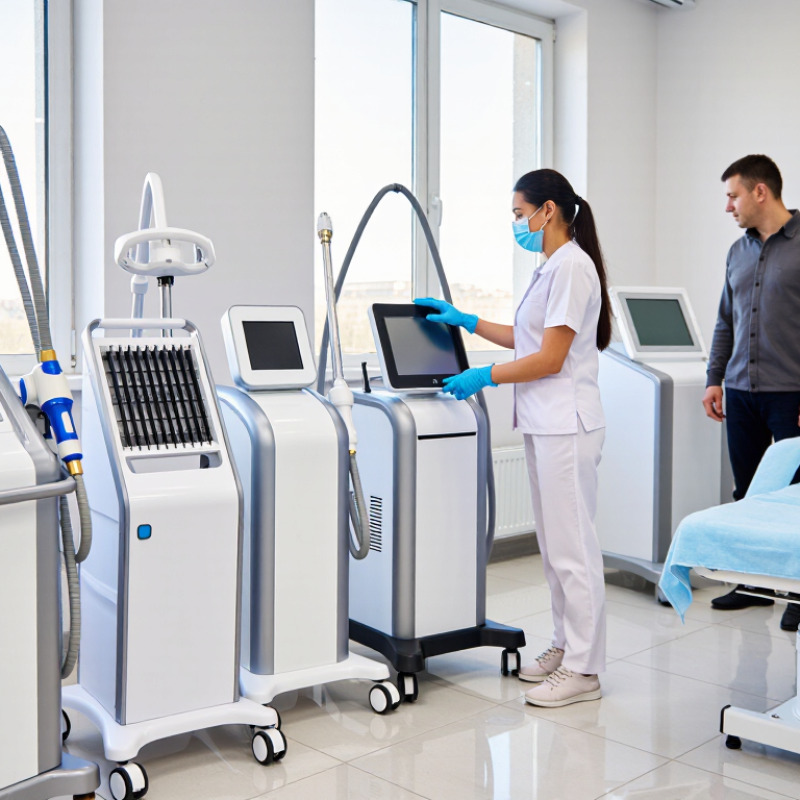
How Laser Hair Removal Machines Work
How Laser Hair Removal Machines Work
Laser hair removal uses selective photothermolysis. The device sends concentrated light into the hair follicle. Melanin absorbs that light and changes it into heat. The heat damages the follicle’s growth structures, while cooling protects nearby skin.
Not magic. Hair must contain enough pigment to absorb energy effectively. Dark, coarse hair usually responds better than fine or very light hair. Hair also grows in cycles, so one session cannot treat every follicle. A 2017 review in Lasers in Medical Science reported long-term hair reduction with diode and alexandrite systems, but results varied by skin tone, hair color, and treatment settings.
Salon machines commonly use different wavelengths for different skin types. Longer wavelengths generally reach deeper and may reduce surface heating in darker skin. Pulse duration, fluence, spot size, and cooling must work together. A powerful setting is not automatically a better setting. In practice, a test area, clean contact surface, and suitable eye protection matter greatly.
Grand View Research estimated the global laser hair removal market at about USD 1 billion in 2023, with strong projected growth through 2030. That expansion increases equipment choices, but it also creates room for careless marketing. Operators should record skin response, review medications, and follow local device regulations. Even experienced technicians can misjudge a first session. Redness may be normal; blistering is not. Performance claims should be checked against technical documentation and clinical evidence, not showroom promises.
10 Best Laser Hair Removal Machines for Salons: How Laser Hair Removal Works
Common professional laser wavelengths used for selective photothermolysis
Professional hair-removal lasers target melanin in the hair shaft and follicle. The absorbed light is converted into heat, which can damage the follicle and reduce future hair growth. Alexandrite, diode, and Nd:YAG systems commonly use different wavelengths to balance melanin absorption, penetration depth, and suitability for different skin types. Multiple treatments are normally required because hair follicles respond best during the active growth phase.
Key Criteria for Evaluating Salon Laser Systems
Choosing among the 10 best laser hair removal machines for salons requires more than comparing prices or promotional claims. According to the ISAPS Global Survey 2023, clinics performed 19.1 million nonsurgical aesthetic procedures worldwide, a 3.3% increase from 2022. This growth raises client expectations. Evaluate wavelength options, adjustable fluence, pulse duration, spot size, and cooling performance. These controls help practitioners adapt treatments for different hair thicknesses and skin tones. Consistent energy delivery matters more than impressive maximum output.
Safety and workflow deserve equal attention. Check electrical certifications, emergency controls, treatment logs, and service support. The system should support documented patch testing and clear contraindication screening. Ask for measured output data, not only laboratory claims. Maintenance costs can quietly reduce profitability. A higher purchase price does not always indicate better clinical value. I would also assess handpiece weight after a full day of simulated treatments. Small ergonomic flaws become expensive problems.
Tips: Request an independent demonstration using different skin tones and hair densities. Review published clinical evidence, warranty terms, calibration schedules, and staff training requirements. Compare treatment speed using realistic settings, not the fastest possible mode. The World Health Organization emphasizes risk management and competent operators for medical devices. Training is therefore part of the machine’s value. One weakness in many salon comparisons is their focus on specifications alone. Real performance depends on technique, patient selection, and honest follow-up records.
The 10 Best Laser Hair Removal Machines for Salons
The 10 Best Laser Hair Removal Machines for Salons
Choosing among the 10 best laser hair removal machines for salons requires more than checking power ratings. A reliable system should offer stable energy delivery, adjustable pulse duration, and effective skin cooling. Diode systems suit many common treatment areas. Alexandrite technology can work efficiently on suitable lighter skin tones. Nd:YAG devices often provide safer options for darker skin when used correctly. Multi-wavelength platforms offer broader flexibility, but they may require deeper training.
Other strong choices include compact trolley units, high-speed multi-spot systems, sapphire-cooled machines, dual-wavelength platforms, and models with automatic skin-temperature monitoring. The best machine depends on client profiles, treatment volume, service areas, and operator skill. A powerful device is not automatically the best device. That assumption deserves reconsideration. Clear manufacturer training, service support, replaceable components, and transparent safety documentation also matter.
Tips: Request a live demonstration before purchasing. Test the handpiece weight during repeated movements. Confirm cooling performance after several pulses. Check whether settings can be adjusted gradually, rather than forcing aggressive treatment. Always complete a consultation, review contraindications, perform a patch test, and use suitable eye protection. Follow local professional and safety requirements. Treatment records should include skin assessment, settings, cooling levels, and client responses. Some salons may prefer speed, while others need comfort and precision. A thoughtful choice leaves room for both.
Matching Machine Types to Skin Tones and Treatment Goals
10 Best Laser Hair Removal Machines for Salons?
Matching Machine Types to Skin Tones and Treatment Goals
Choosing among the ten best salon machines starts with skin tone, not advertising claims. Alexandrite systems often suit lighter skin with dark hair and can deliver fast coverage. Diode systems offer flexible settings for many light-to-medium skin tones. Nd:YAG systems generally provide a safer option for deeper skin tones because their longer wavelength targets the follicle with less surface absorption. IPL is not a laser, but it may support hair reduction when carefully matched to the client.
Treatment goals also change the decision. A large back needs a reliable cooling system, broad spot size, and steady pulse delivery. Small facial areas need precise handpieces and conservative energy control. Coarse hair may respond differently from fine, pale hair. Pale or gray hair can remain difficult because it contains little pigment. No machine wins every case.
A trained practitioner should check tanning, medication history, sensitivity, and hair growth patterns before treatment. A patch test matters, especially for deeper skin tones or recently tanned clients. Record the settings, response, and healing time after every visit. That record improves future adjustments. Higher energy is not automatically better. I have seen treatment plans become too aggressive when speed replaced careful observation. Cooling, clean contact surfaces, protective eyewear, and verified operator training are essential details, not decorative extras. Realistic results usually require several sessions because hair grows in different cycles.
Safety Standards, Staff Training, and Equipment Maintenance
Safe results begin before the first pulse. The ISAPS 2023 Global Survey recorded more than two million laser hair-removal procedures worldwide, showing the service’s growing demand. That demand also raises operational risks. Salons should follow ANSI Z136.1 laser-safety guidance and the applicable IEC 60825-1 equipment requirements. Protective eyewear must match the device wavelength, not simply look professional. Keep it visible beside the treatment bed.
Staff training should cover skin assessment, contraindications, patch testing, cooling methods, and emergency response. Training records need dates, instructor names, and practical assessments. A certificate alone proves very little. The FDA’s laser-product guidance emphasizes user controls, labeling, and documented safety procedures. Staff should also understand when to pause treatment and refer a client for medical assessment. Clear communication matters, especially when clients report unusual pain, blistering, or pigment changes.
Maintenance is often treated as paperwork. It should be physical and measurable. Before each session, inspect handpieces, cables, cooling surfaces, warning lights, and protective eyewear. Record pulse counts, error messages, cleaning, and calibration dates. IEC 60825-1 supports controlled operation and risk management, but standards cannot replace judgment. A checklist can still fail when staff sign it without looking. Managers should schedule manufacturer-approved servicing, isolate damaged equipment, and review incident logs monthly. Even experienced teams need refresher training; routine work can create careless habits.
Conclusion
Choosing the right Laser Hair Removal Machine is essential for salons that want to provide effective, comfortable, and consistent treatments. This guide explains how laser hair removal systems target hair follicles and examines the key criteria for evaluating professional equipment, including wavelength options, energy control, cooling technology, treatment speed, usability, and long-term reliability. It also presents ten leading machine types suitable for salon environments, without focusing on specific brands.
The article further explains how to match different laser technologies with various skin tones, hair colors, and treatment goals. In addition, it highlights the importance of safety standards, proper staff training, client assessment, protective procedures, and regular equipment maintenance. By considering performance, versatility, safety, and operational needs together, salon owners can select a system that supports high-quality treatments while promoting client confidence and responsible professional practice.
 Aidiesin
